Pyuika Rider tradition
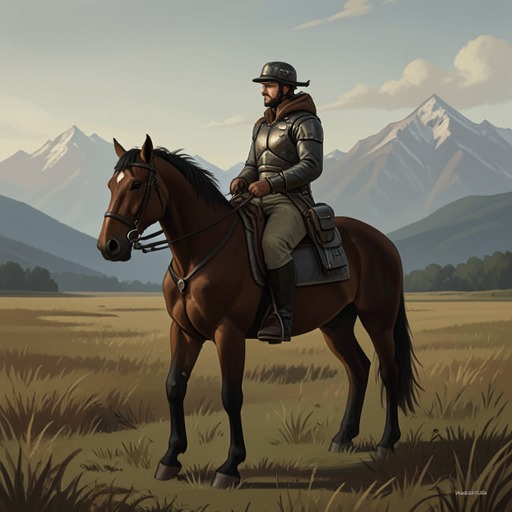
The Deer KingThe Pyuika Rider tradition is the Toga mountain clans’ inherited way of raising, training, and riding pyuika. Its foundation is not confinement but knowledge: riders learn the animals’ seasonal movements, individual bonds, breeding, and needs, and adapt their own practices accordingly. When Van carries this tradition into Oki, it helps the people care for and breed pyuika, but it also reveals the limits of Zolian plans to treat them as ordinary military stock.
Origins and Meaning
In Van’s homeland, pyuika were precious companions raised specifically for riding, not the all-purpose source of food, clothing, and transport that reindeer were for the Oki. The difference reflected the two communities’ environments and livelihoods: the Toga Mountains had fertile valleys, game, herbs, and trade routes, while the Oki depended heavily on reindeer and their seasonal pastures. For Van, returning to pyuika work rekindles his sense of himself as a Pyuika Rider, even after displacement has separated him from his homeland.
The tradition is also self-critical. Van remembers his father’s warning that riders use pyuika for their own purposes and should not disguise that fact with stirring songs. The rider’s bond is real, but it does not erase the animal’s role as a mount in human plans. Van takes this thought seriously when he must choose whether to help the Oki raise animals that Zolian forces might eventually ride: he recognizes that his objection to their use belongs to him, while the pyuika themselves were brought there without choosing their fate.
Learning the Animals
Toga children learn by accompanying the adults and watching the roaming herds. From an early age, they observe how fawns are selected and how bonds with people are formed; through this daily attention, they acquire the ability to identify and train suitable pyuika. Van explains to the Oki that restraint is not the answer. Pyuika are wilder than reindeer and resist being kept like conventional livestock. Their handlers must instead accustom them to human presence and nurture a personal connection.
That connection begins early and can endure for life. A pyuika bonded to a person while still a fawn will remember that person and answer a whistle; the animals are loyal, but can become lonely when separated from those with whom they have bonded. They are herd animals, though their herds are broad and loosely organized, with a doe and her fawns forming the clearest family unit. Van’s description makes an intimate bond, rather than simple command, the basis of dependable handling.
The riders’ ecological knowledge extends to movement and enclosure. Pyuika migrate seasonally along habitual routes and range less widely than deer. Mohoki, a lichen they avoid, can be braided into ropes and placed around a fence to keep them from crossing it; it can also be planted strategically along their routes to influence where they travel. Yet using this knowledge to pen them does not make constant enclosure suitable: as grazers, they are better left to roam by day, with confinement reserved for protection at night when wolves are active. The distinction is between managing movement with an understanding of animal habits and trying to suppress those habits altogether.
Breeding and Training for Riding
Pyuika husbandry requires careful selection and long planning. The animals usually bear twins, and tradition chooses the stronger, larger fawn for human bonding while leaving the weaker one with its mother. Van recalls his father’s singsong instruction, “The weak one to the mother, the strong one to me.” The rule makes clear that the practice depends on reading each animal’s development, not merely separating young at random.
Both male and female pyuika can be trained as mounts, but males become difficult to control during mating season. Those selected for riding are therefore gelded before maturity. Because removing too many strong males would weaken the next generation, the clan considers the condition of the herd when deciding how many fawns to train. Geldings retain their antlers in spring, despite other bucks shedding theirs, and trade some muscular strength for greater stamina and obedience. Training animals for riding must therefore be balanced against preserving a viable herd.
Van brings this knowledge to Ohma’s family after the Oki have bought pyuika from traders who did not tell them about mohoki. Without that lichen, they struggle to keep the animals safely penned; if a fence prevents escape without addressing their needs, the pyuika can decline. The Oki have borrowed heavily and risk further taxes if their breeding attempt fails, so this omission threatens their livelihood as well as the animals’ welfare. Van teaches them how to manage the herd, and in spring persuades the men to let the pyuika roam freely rather than keep them restrained. He argues from their behavior: they cannot be domesticated by force, but can be brought into lasting association with people.
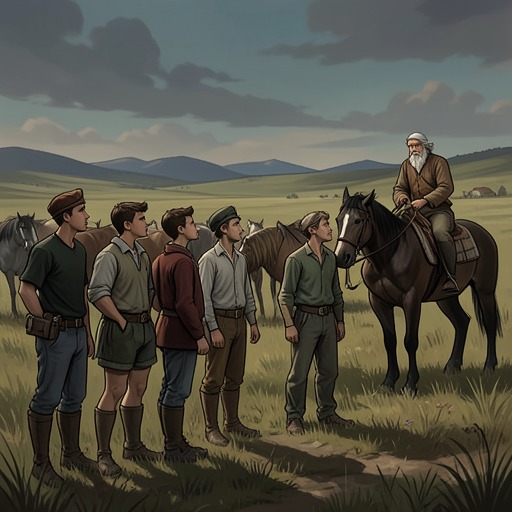
The tradition also gives Van a way to train the next generation of handlers. When the pyuika fawn, he shows young Oki men how to judge a fawn’s strength by the way its legs and hips move and whether it is getting enough milk. He identifies the stronger second-born as the more promising mount, then explains that the crucial bonding period begins while the mother is away, when people can approach gradually and let the young animals become familiar with their scent. The lesson passes on a practice formed by observation, with the trainees’ excitement marking a new connection between Toga knowledge and Oki life.
Imperial Plans and Local Consequences
The Zolian authorities assume pyuika can be bred like horses, but Van knows the comparison is misleading. A suitable riding male must be selected at birth and gelded before maturity, while breeding the herd at the same time; producing usable mounts takes considerable time. Although Van’s instruction gives Ohma’s family a better chance of breeding pyuika, successful husbandry does not necessarily serve the Oki’s interests. The Zolians might withdraw the tax reduction offered to breeders once they realize the animals are not useful to them in the way they expected.
Van sees a further risk in the animals’ dependence on early bonds with their handlers. If Zol understands that pyuika will bond with the people who raise them, it could conscript young Oki men to serve as riders in a frontier force. The tradition that helps the Oki succeed could thus make their skills legible to the empire and expose them to a new form of control. Van does not burden Ohma with this possibility while the family is still trying to breed the herd; he first concentrates on Tsupi’s safe calving and on the chance that the pyuika will produce young the following year.
Seasonal demands complicate the project further. Reindeer must move to summer pasture when horseflies and mosquitoes become severe and the grasses near their winter grounds are thin. Their migration coincides with pyuika calving, so asking the pyuika to follow the reindeer—as they had done in the previous year—may have contributed to the failure to breed. Van and Ohma’s family consult neighboring households. Three of Kiya’s nephews remain behind to learn pyuika care while the others take the reindeer to their usual summer pasture, and Kiya stays to care for Yuna. The solution depends on local cooperation as much as on specialized expertise.
Care, Limits, and Significance
The tradition does not make pyuika invulnerable or remove conflict between human needs and animal life. Wolves may attack them, but the Toga practice is to drive wolves away with fire or shouting rather than kill them as if they were ordinary prey. A more severe rite is considered only if wolf numbers become so great that they no longer respond to respectful efforts to ward them off. This approach places animal care within a wider set of obligations and limits, rather than treating every threat as permission for unrestricted violence.
Winter care makes that attentiveness practical. During mating season and pregnancy, pyuika eat large quantities of ashimi, a green lichen that remains available beneath frost. Van collects it from the woods and lays it before Tsupi, a difficult task made somewhat easier by his ability to find the lichen by smell. The work is tied to the hope that the does will bear strong calves; husbandry is not only a matter of training mounts, but of attending to nutrition and seasonal needs.
Through Van, the Pyuika Rider tradition becomes more than a remnant of a lost homeland. It offers the Oki concrete means to care for unfamiliar animals and a way to recognize why imperial expectations may fail. At the same time, its success cannot guarantee freedom: the knowledge that enables bonding and breeding may also invite taxation or conscription. The tradition’s central tension is therefore practical and ethical alike—how to help people and animals live together without pretending that service to human purposes carries no cost for the pyuika.